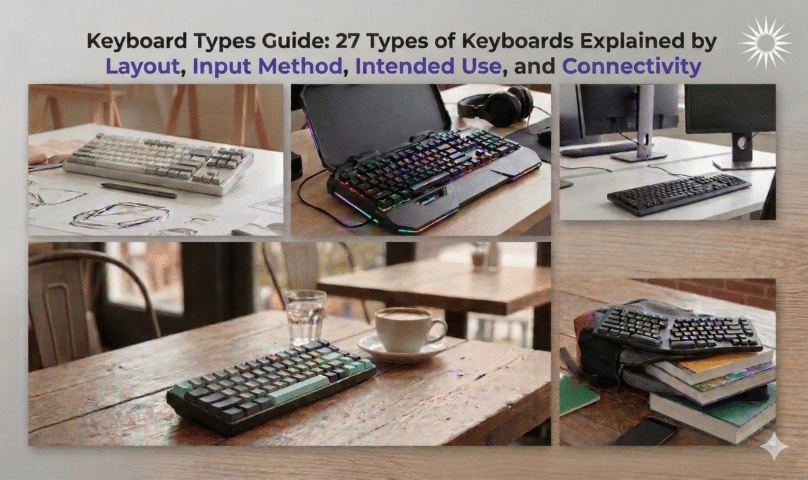
Keyboard Types Guide: 27 Types of Keyboards Explained by Layout, Input Method, Intended Use, and Connectivity
The modern peripheral market is saturated with options, leaving most users typing on hardware that actively fights against their daily workflow.
This guide acts as a strict filtering mechanism designed to replace subjective “feature shopping” with objective “workflow fitting.” This guide details the Keyboard Types framework, defining the critical constraints for Layout, Input Method, Intended Use, and Connectivity to isolate your perfect hardware match.
The Four Pillars of Classification
Input
Mechanical, Membrane, Optical, Capacitive.
Layout
100%, TKL, 60%, Split, Ortholinear.
Use Case
Gaming, Office, Ergonomic, Industrial.
Connectivity
Wired, 2.4GHz RF, Bluetooth, Hybrid.
Why Are There 27 Different Keyboard Types in the Modern Input Ecosystem?
Keyboards have evolved from universal typewriters into highly specialized tools engineered for specific friction points.
Figure 1.0: The Input Peripheral Taxonomy Filter. Isolating the 27 market variants through four objective data pillars to eliminate subjective decision fatigue.
Decoding the Input Peripheral Taxonomy
Never buy a keyboard based purely on aesthetics; buy based on workflow friction. The modern market features 27 distinct keyboard types because user workflows have specialized. Through structured analysis, buyers move from passive consumers to hardware strategists.
The Four Pillars of Classification (The Framework)
To navigate this ecosystem, you must stop looking at brands and start looking at structural pillars. We categorize every device across four strict axes: Input (the actuation mechanism), Layout (the physical geometry and key count), Use Case (the specific job environment), and Connectivity (the data transmission protocol).
Which Mechanical or Sensor Keyboard Fits Your Typing Style?
The foundation of your typing experience is defined by the physical mechanism resting beneath the keycap.
Figure 2.0: Actuation Architecture. Mechanical architectures utilize discrete springs and metal contacts, whereas membrane systems rely on continuous silicone pressure pads.
The Physical Switch Classifications
Switch architecture determines the tactile feedback and auditory signature of your input.
- Mechanical keyboards: Focus on durability. They boast an industry-standard 50–100 million keystroke rating. However, mechanical switches suffer from contact bounce, requiring a built-in 5-millisecond debounce delay.
- Membrane keyboards: Focus on budget efficiency and utilize sealable, unified pressure pads.
- Capacitive & Optical: Contrast electrostatic sensors with light induction. Optical switches eliminate debounce delay entirely, making them superior for absolute input speed.
The Virtual and Advanced Sensor Classifications
When physical space reaches absolute zero, input methods shift from mechanical switches to optical sensors and software. Projection and Virtual keyboards exist for extreme travel and accessibility scenarios where hardware bulk is unacceptable.
FFitts Law Integration: Traditional Fitts’s Law fails on touchscreens due to the “Fat Finger” problem. The FFitts model (Google Research: FFitts Law & Virtual Touchscreens) introduces a dual-distribution hypothesis that accounts for absolute finger touch precision on glass, mathematically predicting virtual input error rates.
How Do You Select Keyboard Types by Form Factor and Key Geometry?
Your keyboard’s physical footprint directly dictates the ergonomic positioning of your entire desk setup.
Figure 3.0: Form Factor Desk Economy. Demonstrating the horizontal space recovered by removing the dedicated numpad and navigation clusters.
The Baseline Form Factor Percentages
Form factor choice is a trade-off between dedicated key access and horizontal desk economy. Layouts are categorized by percentages: 100% (Full-size, ~104 keys), 80% (Tenkeyless/TKL, ~87 keys), and 60% (Compact, ~61 keys). The smaller the percentage, the closer your mouse hand can sit to your body’s centerline.
The Desktop & Minimalist Layouts
Beyond Standard keyboards, the market divides into Standalone blocks, Ultra-Slim profiles, and Mini configurations. Each reduction in size demands heavier reliance on software layer macros to access missing keys.
The Alternative and Accessible Geometries
Standard staggered layouts are a relic of the typewriter era; alternative geometries exist to fix the physical damage they cause. To correct biomechanical strain, users shift to Split or Ortholinear (grid-aligned) keyboards.
Ergonomic Angles & Ulnar Deviation: Standard boards force 10–15 degrees of ulnar deviation (outward bending of the wrists). Citing JOSPT Ergonomic Research , utilizing a split board with a 12.5-degree slant (creating a 25-degree central opening) neutralizes this bend back to a safe 0 degrees.
Which Specialty and Purpose-Built Keyboard Types Match Your Daily Workflow?
Extreme environments and specialized tasks require hardware engineered beyond standard consumer specifications.
Performance & Environment
For competitive Gaming, boards feature Hall Effect sensors or rapid-trigger optical inputs. Ergonomic keyboards prioritize health over raw speed. In commercial settings, Industrial and Flexible (silicone roll-up) keyboards offer IP68 waterproofing and extreme durability against contaminants.
Media & Niche Classifications
Some keyboards are designed not for the office desk, but for the living room, the server rack, or the design studio. This category includes Multimedia centers, Trackpad-integrated HTPC boards, Handheld mini controllers, retro Typewriter mechanicals, and specialized Dock accessories for tablets.
How Do You Choose Between Connectivity Protocols for Your Input Device?
How your keyboard talks to your computer determines both your desk’s cleanliness and your input latency.
Figure 4.0: The Latency Spectrum. Visualizing data transmission delay based on standard connectivity protocol benchmarks.
The Baseline Data Transmission Standards
Connectivity protocols are defined by the competing demands of power, speed, and mobility. Latency determines viability. Wired USB operates at ~1ms. High-end 2.4GHz wireless dongles manage ~1–5ms, making them viable for competitive use. Bluetooth operates at ~20–40ms+, strictly relegating it to casual office tasks. Rapoo Connectivity & Latency Data validates these constraints.
Polling Rates: Standard boards report data to the PC at 1000Hz (1ms intervals). Upgrading to an 8000Hz polling rate reduces the reporting interval to a blistering 0.125ms.
The Ultimate Multi-Device Solution
Modern professionals rarely work on a single screen anymore. Hybrid Connectivity represents the apex of modern taxonomy. These keyboards pack USB-C wiring, a 2.4GHz dongle, and 3+ Bluetooth profiles into a single PCB, allowing a user to seamlessly juggle a desktop PC, a travel laptop, and a tablet with a physical toggle switch.
How Do You Execute a Step-by-Step Audit to Find Your Ideal Keyboard Type?
Choosing the right keyboard requires an honest audit of how you actually spend your time at the desk.
The Workflow Assessment
Identify the physical bottleneck before identifying the product.
Is your primary friction speed (gaming), pain (ergonomics), desk space (layout), or noise (acoustics)? Isolate one.
Cross-reference that bottleneck against the Master Comparison Matrix to eliminate incompatible hardware categories immediately.
Semantic Execution: Auditing workflow → eliminates incompatible hardware → revealing the exact keyboard type required.
How Can You Prevent Common Hardware Mismatches When Choosing a Keyboard Type?
Falling for marketing hype often leads to buying the right keyboard for the wrong job.
Troubleshooting Input and Layout Errors
Mismatched hardware creates subtle friction that eventually leads to repetitive strain or data entry errors.
-
Thumb Keyboard vs. Essay: Buying a tiny handheld keyboard for extensive writing. Fix: Restrict thumb boards to server/HTPC admin tasks.
-
Flexible vs. Speed: Buying a silicone roll-up keyboard for high-WPM typing. Fix: Use flexible boards solely in contamination-heavy industrial zones.
-
Standard vs. Carpal Tunnel: Refusing to switch from a staggered 100% board while experiencing ulnar nerve pain. Fix: Immediately transition to an Ortholinear or Split ergonomic geometry.
Master Comparison Matrix: Filter All 27 Keyboard Types by Core Pillars
Use this master matrix to filter all 27 keyboard types against your audited workflow requirements.
| Keyboard Category | Layout Format | Input Method | Intended Use | Connectivity |
|---|---|---|---|---|
| Mechanical | All Layouts | Mechanical Switches | Enthusiast / Customization | Varies |
| Membrane | Full / TKL | Rubber Dome | Budget / General Office | Wired / Wireless |
| Capacitive | Full / TKL / Compact | Electro-Capacitive (Topre) | Premium Tactile Typing | Wired / Wireless |
| Optical | Full / TKL / Compact | Light Induction | Ultra-Fast Gaming Response | Wired |
| Chiclet | Compact / Full | Scissor Switch | Laptops / Low-Profile Typing | Wireless / Wired |
| Projection (Laser) | Virtual Full-Size | Optical Sensor | Tech Demos / Extreme Travel | Bluetooth |
| Virtual On-Screen | Dynamic / Variable | Touchscreen | Tablets / Smartphones | Internal |
| Standard | 100% Full-Size | Membrane / Mechanical | Basic Computing / Data Entry | Wired / Wireless |
| Standalone | Standard | Varies | Standard Desktop Setups | Varies |
| Compact | 60% to 75% | Varies | Space-Saving / Minimalism | Varies |
| Slim | Full / Compact | Scissor / Chiclet | Aesthetic / Modern Office | Bluetooth / 2.4GHz |
| Mini | Ultra-Compact | Membrane / Scissor | Media Centers / HTPC | Bluetooth / 2.4GHz |
| Split | Separated Halves | Mechanical | Posture Correction / Comfort | Wired / Bluetooth |
| Ortholinear | Perfect Grid | Mechanical | Efficiency / Coding | Wired |
| One-Handed | Halved / Macro Pad | Mechanical | Gaming / Accessibility | Wired |
| Thumb | Ultra-Compact | Membrane | Mobile Devices / Handhelds | Bluetooth |
| Chorded | 5-7 Key Clusters | Mechanical | Stenography / Accessibility | Wired |
| Gaming | Full / TKL / Compact | Mechanical / Optical | Esports / Low-Latency Input | Wired / 2.4GHz |
| Ergonomic | Split / Angled / Alice | Mechanical / Membrane | RSI Prevention / Health | Varies |
| Industrial | Standard | Membrane / Capacitive | Factories / Medical / Harsh | Wired |
| Flexible (Roll-Up) | Standard / Compact | Membrane / Sensor | Travel / Harsh Environments | Wired / Bluetooth |
| Multimedia | Full + Macro Keys | Varies | Entertainment / Video Editing | Wireless / Wired |
| With Trackpads | Compact / Full | Scissor / Membrane | Server Rooms / Couch Typing | Wireless |
| Handheld | Mini / Controller | Membrane | Living Room / Presentations | 2.4GHz / Bluetooth |
| Typewriter | Standard / Compact | Mechanical Switches | Retro Aesthetics / Novelty | Bluetooth / Wired |
| Keyboard Docks | Compact | Scissor / Chiclet | Tablet Conversion / 2-in-1s | Direct / Bluetooth |
| Hybrid Connectivity | Varies | Varies | Multi-Device Juggling | Bluetooth + 2.4GHz + Wired |
*Matrix condenses all 27 specialized sub-types across the 4 foundational classification pillars.
Glossary of Peripheral Terms
To ensure full clarity, this glossary defines the key technical and ergonomic terms used throughout this guide.
Which of the 27 Keyboard Types Is Ultimately Right for You?
Run your final choice through this diagnostic checklist to guarantee a workflow match before purchasing.
The Purchase Verification
Conclusion
In conclusion, the Keyboard Types Guide transforms the purchasing process from a guessing game into a precise science. Matching layout and input to workflow is the only path to efficiency.
“At SETUP_DOCTOR_OS, we believe hardware optimization is the only path to sustainable digital productivity. Stop shopping for features and start fitting for workflow—your ideal keyboard is a tool, not an accessory.”
© 2026 Hardware Optimization Framework. All rights reserved.